- You do not have any products in your shopping cart yet.
✔ Self-learning
The OBD-Killer learns the stored fault codes and is suitable for learned, emissions-related and intermittently occurring fault codes.

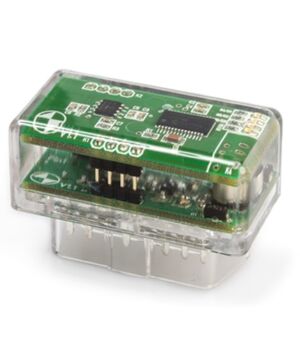
The OBD-Killer learns the stored fault codes and is suitable for learned, emissions-related and intermittently occurring fault codes.
While driving, the engine control unit is monitored in real time for intermittent faults.
Pending learned fault codes are detected and cleared automatically before they create a permanent warning message in the instrument cluster.
Suitable for almost all vehicles from model year 2008. Simply plug the OBD-Killer into the diagnostic port.
OBD stands for on-board diagnostics, the standardised diagnostic interface used in motor vehicles. The OBD-Killer is a compact electronic module that plugs directly into this diagnostic port. It monitors the engine control unit's fault memory in real time. When the device detects a previously learned pending fault code, it clears it automatically before it creates a permanent warning message in the instrument cluster.
The OBD-Killer continuously monitors the engine control unit's fault memory. As soon as a previously learned fault code becomes pending, the device detects and clears it automatically before it creates a permanent warning message in the instrument cluster. Fault codes that are active and learned during installation are also handled.
The OBD-Killer is generally suitable for many vehicles from model year 2008 onwards. Some older vehicles already support the required standard. One indication is that pins 6 and 14 are populated on the diagnostic port. Fuel type is irrelevant: the device can be used in diesel, petrol, natural-gas and LPG vehicles. However, the engine control unit must support clearing fault codes while the engine is running.
The OBD-Killer is self-learning and can automatically detect and clear learned emissions-related fault codes. During installation, the device stores the existing codes as expected faults. The learning process can be repeated whenever required. Typical examples include P0401 for exhaust gas recirculation faults and P0420 for catalyst efficiency below threshold. Manufacturer-specific codes can also be taken into account. If a fault occurs later that has not been learned, the OBD-Killer does not intervene. This means that the fault memory and check engine light remain fully functional for other warnings.
The OBD-Killer is particularly suitable for intermittent emissions-related faults. Examples include EGR codes P0400 to P0408 and catalyst codes such as P0420 to P0424 and P0430 to P0434. Following performance modifications or in cases of unresolved turbocharger issues, P0234 may also occur, indicating an overboost condition. In motorsport applications, the device is also used after relevant modifications, for example in connection with an OPF/GPF delete.
Yes. The OBD-Killer can be reused in another compatible vehicle. When the device detects a new vehicle identification number after installation, the previous learned values are reset automatically. The OBD-Killer can then be learned again for the new vehicle.
No. The technical cause of the fault should always be professionally checked and repaired where possible. The OBD-Killer is intended for cases in which an intermittent fault returns despite inspection or repair, or where no clear cause can be found. It does not replace necessary repairs to safety-relevant or permanently defective components.
The OBD-Killer detects previously learned emissions-related fault codes such as P0401, P0420, P0430 or P0234 and intervenes automatically when they return. New and unlearned faults remain visible.
Simply plug it into the OBD port. No conversion, app or change to the engine software is required.
During installation, existing fault codes are stored as expected faults and are handled selectively when they return.
Only previously learned faults are taken into account. New or unknown faults remain visible in the fault memory and instrument cluster.
Suitable for many EOBD/OBD-II CAN vehicles. When the device detects a new vehicle identification number, the previous learned values are reset automatically.
The OBD-Killer is frequently used for the following recurring emissions-related fault codes.
Typical faults relating to low catalyst efficiency or catalyst warm-up.
P0420, P0421, P0422, P0423, P0424
P0430, P0431, P0432, P0433, P0434
Faults relating to EGR flow, control, position and electrical actuation.
P0400, P0401, P0402, P0403, P0404
P0405, P0406, P0407, P0408
Used for recurring boost-pressure control deviations.
P0234 – Turbocharger overboost condition
The OBD-Killer can also take other learned emissions-related and manufacturer-specific fault codes into account. Unlearned faults remain visible.
{{.}}
{{/content}}{{{.}}}
{{/content}}